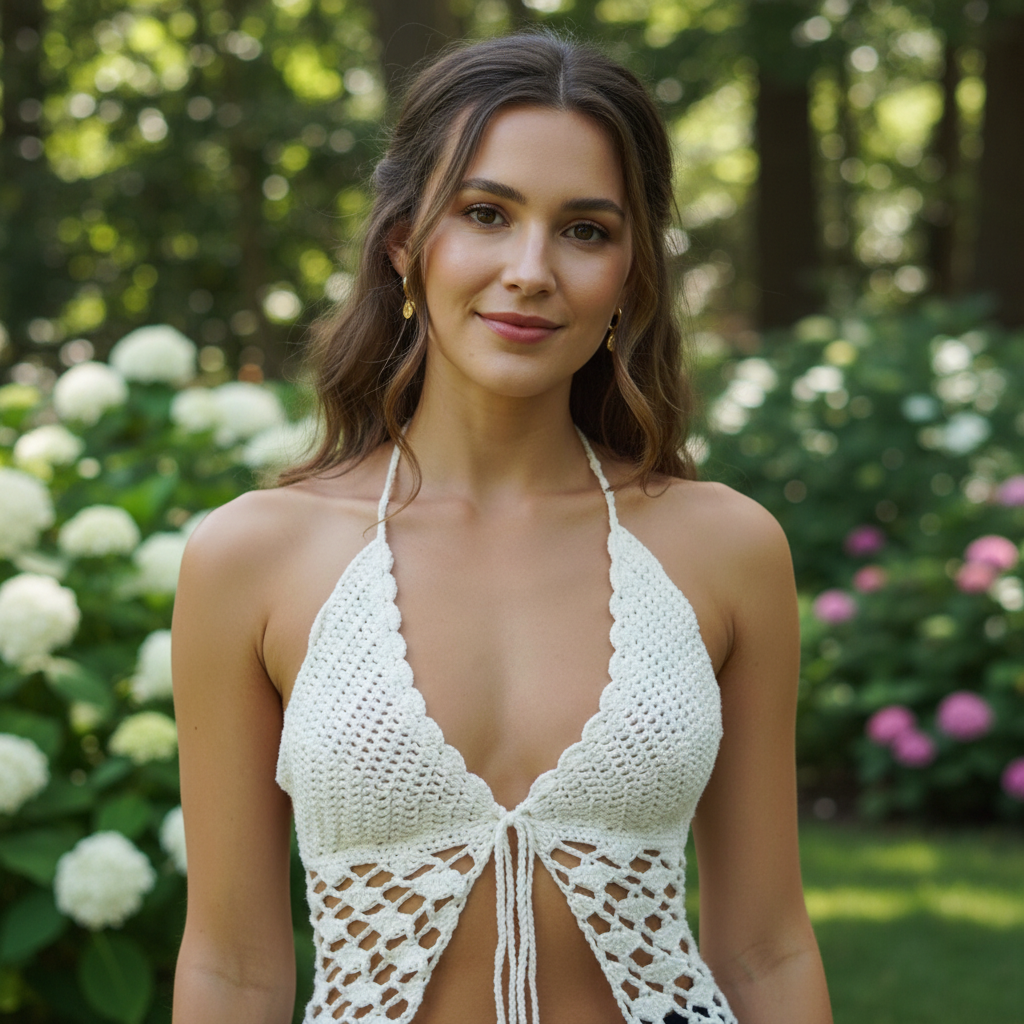
Learn how to crochet the Butterfly Lace Top — a free intermediate crochet pattern featuring a shell stitch skirt, sculpted cups, and a tie-front corset strap. Perfect for summer.
Free Crochet Pattern: Butterfly Lace Top
Skill Level: Intermediate · Hook: 3.5mm · Yarn: DK Weight · Time: Weekend Project
There’s something about a handmade crochet top that just hits different. You wear it and someone always asks — “Did you make that?” — and you get to say yes with a very satisfied smile. That’s exactly the feeling this Butterfly Lace Top was designed to give you.
I designed this top for myself first, working through several versions until the fit felt right. The cups are shaped with simple increases and short rows, the strap is a long crocheted chain that ties at the front like a little corset ribbon, and the skirt section uses a classic shell stitch that gives that beautiful openwork texture without being fiddly to work. The whole thing comes together in a weekend if you have a few uninterrupted hours to yourself.
This pattern is sized to my own measurements — I’ve included my full stats below and a guide for adjusting to yours. As always with handmade garments, measure as you go and trust your gut when something needs tweaking. Crochet is wonderfully forgiving.
Designer’s Note: I’ve been crocheting for about six years and I’m always chasing that balance between something that looks complicated but is actually quite relaxing to make. This top is exactly that. The cup section involves a little shaping (nothing scary, I promise), and once you hit the shell stitch rows, it’s almost meditative. I made my first version in white cotton yarn sitting on my balcony in the summer — it felt very right. I hope yours feels the same way. — CrochetingPT, designer & maker
What You’ll Need
- Yarn: 100g DK weight yarn. Cotton or cotton-blend works best for drape and breathability. A smooth white DK is recommended.
- Hook: 3.5mm crochet hook. Go up to 4mm if your tension runs tight.
- Notions: Yarn needle for weaving ends, scissors, stitch markers (optional but helpful for the cup shaping).
- Gauge: Not strictly critical for this design, but aim for approx. 18 dc × 10 rows = 10cm square in double crochet.
Yarn Tips: A smooth, plied DK cotton will give you the crispest stitch definition, especially in the shell stitch section. Avoid anything too fuzzy or textured — you want the lace openwork to actually show. If you’re going for a softer, slightly drapier look, a cotton-viscose blend is lovely. 100% acrylic will work if that’s what you have, but it won’t have the same breezy summer feel.
Designer’s Measurements
| Measurement | cm | Inches |
|---|---|---|
| Bust | 82 cm | ~32″ |
| Underbust | 69 cm | ~27″ |
| Underbust to collarbone | 26 cm | ~10″ |
How to Adjust Your Size:
For the cups: The number of rows you work directly controls the height and width of each cup. The pattern gives 15 rows for the main triangle section — add 1–2 extra rows if you need more coverage, or stop a row earlier for a smaller cup. The cup width at the base is approx. 15cm and height approx. 22.5cm.
For the shell stitch border/skirt: Your starting chain must be divisible by 12. The designer used 32 sc + 56 ch + 32 sc = 120 total. Add or remove multiples of 12 to widen or narrow your piece. The shell stitch section can be worked to whatever length you prefer.
For the strap: The strap chain is 100 stitches. Shorten or lengthen based on your neck measurement and preferred tie style.
Abbreviations
- ch — chain
- slst — slip stitch
- dc — double crochet
- sc — single crochet
- inc — increase (2 sts in same st)
- sk — skip
- st(s) — stitch(es)
All double crochets are US terms throughout this pattern.
The Pattern
Make two cups — one for each side. They are identical until the very last two rows where the shaping shifts slightly.
Part 1 — Cup (Make 2)
The cup is worked in rows, starting from a small loop at the centre top, building outward in a triangle shape. Increases run up the right-hand edge (or left, depending on which cup you’re making). The cup is approx. 15cm wide at the base × 22.5cm tall.
Step 1: Ch 5, slip stitch into the first chain to make a loop.
Step 2: Ch 2, work 4 dc into the loop, turn. (5 stitches total.)
Step 3: Ch 2, dc into same st, dc, inc, dc × 2, turn. (7 stitches total.)
Step 4: Ch 2, dc until middle stitch, inc in middle stitch, dc until the end, inc in last stitch, turn. This row builds both edges. The increase at the end creates your straight side edge; the increase in the middle keeps the top shaping neat.
Step 5: Ch 2, dc into same st, dc until middle stitch, inc in middle stitch, dc until the end, turn. One increase only on this row — at the middle.
Repeat Rows 4 and 5 alternately until you have 15 rows total. This builds your cup triangle. Check against your measurement as you go — the base should be approximately 15cm wide and the height approximately 22.5cm when you hold it up. Adjust by adding or removing rows here.
Final Shaping Rows (starting on the increase side):
Row 16: Ch 2, dc in same stitch, inc in middle stitch, dc until 8 dc remain, turn. You leave 8 stitches unworked at the end — this begins the underarm curve.
Row 17: Ch 1, 8 sc, ch 1, dc, inc, dc until the end, inc in last stitch, turn. The single crochet section creates a softer curved edge at the top of the cup.
Row 18: Ch 2, dc in same stitch, dc until 8 dc remain, turn.
Row 19: Ch 1, 8 sc, ch 1, dc until the end, inc in last stitch. Do not turn — move on to the Strap.
Cup Construction Tip: As you work the cup, lay it flat every few rows and compare it to your own measurements. The triangle should be long and narrow — it wraps from the centre of your chest around and the point sits at the top near the collarbone. If your cup feels too narrow across the base, add one more repeat of rows 4–5. Trust the measuring tape, not the stitch count alone.
Part 2 — Strap & Border
After completing Row 19 of the cup, you work directly into the strap without fastening off. The border is worked along the edge of the cup afterwards, framing it beautifully.
Step 1: From where you left off at the end of Row 19, ch 100, then sc back down the entire chain length. This creates your halter neck strap. Adjust the chain length if your neck is longer or shorter.
Step 2: Slip stitch into Row 19 to anchor.
Step 3: SC in the same row as your slip stitch.
Step 4: Work 4 dc in the next row, then sc in the following row. Continue alternating 4dc / sc all the way down the side edge to the bottom of the cup. This creates a pretty scalloped edge down the outside of each cup. Keep your tension even — not too tight or the cup will pull inward.
Step 5: When you reach the starting loop at the tip of the cup, work 5 sc into the loop.
Step 6: Work 2 sc in each row along the bottom edge of the cup (the base of the triangle).
Step 7: Fasten off, leaving a long tail for seaming or weaving.
Part 3 — Shell Stitch Skirt / Band (Bottom Section)
This is the openwork shell stitch section that forms the body of the top below the cups. It’s worked separately and then joined to the cups, or worked as a border panel depending on how you assemble the piece.
Starting chain formula: SC + Ch + SC = total — must be divisible by 12
Designer’s measurements: 32 sc + 56 ch + 32 sc = 120 total. Add or subtract in multiples of 12 to fit your size.
Row 1: Ch 2, 2 dc in same stitch, sk 2, (sc, ch 5, sk 5, sc, sk 2, 5 dc, sk 2), 3 dc, turn. Work the section in brackets as many times as needed across your chain, ending with 3 dc before turning.
Row 2: Ch 1, sc in same stitch, (ch 5, sc in 3rd stitch of ch 5, ch 5, sc in 3rd stitch of 5dc), turn. This row sets up the chain-5 arches that form the upper part of each shell. Work the bracket section across the row.
Row 3: Ch 5, (sc in 3rd st of ch5, 5 dc in the sc, sc in 3rd st of ch5, ch 5), ch 2, dc in last stitch. The butterfly / shell shapes will become clear in this row. Those 5dc fans are your shells!
Row 4: Repeat Row 2.
Repeat Rows 1–4 until your shell stitch panel reaches your desired length. A longer panel gives more coverage; stop earlier for a very cropped look. For reference, 4–6 full repeats gives approximately 10–15cm of depth.
Joining Strap / Corset Tie: Make a chain of 520 stitches. This is the long tie that weaves through the top of the shell stitch section, crossing from one cup to the other like a corset. Thread each end through the opposite cup (right end through left cup, left end through right cup). Pull through and tie at the front for the corset-style finish. This is what gives the top its butterfly shape when worn.
Putting It Together
Assembly is straightforward but worth doing slowly so everything sits well:
- Make both cups and complete the strap and border edging on each.
- Work your shell stitch panel to your desired length.
- Join the two cups to the top edge of your shell stitch panel — pin them in place first to check the spacing. The cups should sit symmetrically, with a small gap at centre front where the tie will pass through.
- Weave in all ends and give everything a gentle press before trying on.
- Thread your ch-520 tie and adjust the fit at the front.
Assembly Tip: Lay both cups on a flat surface before seaming to make sure they are mirror images of each other. It’s easy to accidentally make two cups in the same direction. One should have its increase edge on the right, one on the left.
Blocking Your Top
Blocking is the step most people skip and then wonder why their finished piece doesn’t quite look like the photos. For a lace piece like this, blocking makes an enormous difference — it opens up the shell stitches, evens out the fabric, and gives the whole top that polished, professional finish.
Wet Blocking (recommended for cotton yarn):
- Soak the finished top in cool water for 15–20 minutes until fully saturated. Don’t agitate — just let it soak.
- Gently squeeze out excess water (never wring). Roll in a clean towel and press to remove more moisture.
- Pin out flat on a blocking mat or folded towel. Gently stretch the shell stitch section to open up the lace pattern, and pin into shape.
- Leave to dry completely — this can take several hours or overnight. Patience here is worth it.
Blocking Tip: When you pin the shell stitch section, gently tug the ch-5 arches upward and outward so the loops open fully. This is where the real lace magic happens — what looks a bit bunched on the hook will spread into those beautiful openwork butterflies once blocked and dry. If you use blocking wires threaded through the chain arches before pinning, you’ll get a very even edge that looks incredibly professional.
Care Instructions
Check your yarn label first and always follow those instructions. As a rule of thumb for cotton DK:
- Hand wash in cool water with a gentle detergent.
- Lay flat to dry — never hang a wet crochet piece as it will stretch out of shape.
- Do not tumble dry cotton — it will shrink and distort the lace pattern.
- If ironing, use a cool setting and press with a damp cloth on top, or steam lightly from above without direct contact.
- Store flat or loosely rolled, not folded on a hanger where the ties can pull the fabric.
Common Questions
I’ve never done shell stitch before — is this pattern suitable for me? If you’re comfortable with double crochet and single crochet and have made at least one garment before, you should be fine. The shell stitch looks more complicated than it is — it’s mostly a rhythm of dc fans and chain arches once you get going. The cup section is the more technical part, requiring you to count increases carefully. This is a confident-beginner to intermediate pattern overall.
My cups came out too big / too small. What now? This is super common with garment crochet and nothing to worry about. If your cups are too big, try a smaller hook (go down 0.5mm) or reduce your row count by 1–2 rows. If too small, go up 0.5mm or add rows. The beauty of working in rows is you can try it against yourself as you go.
Can I make this in a different yarn weight? Yes, but expect to adjust. Going up to worsted weight will give you a more substantial, less sheer result. Going down to a fingering or lace weight will make it incredibly delicate but you’ll need a lot more rows to get the same dimensions. Always swatch and check your measurements before committing to a full cup.
How do I make sure both cups are identical? Make them one right after the other without putting the project down between them. Count your rows carefully and write them down. Notes on paper are your best friend here.
A Final Note from the Designer
I love seeing this top made up in different yarns and colours. The white version is my personal favourite because the lace really shines through, but I’ve also seen it worked in sage green, soft terracotta, and a beautiful pale blush — all stunning. If you make this, please tag me so I can see your version. There’s nothing I love more than seeing how different makers interpret the same pattern.
Happy hooking. ✨
— CrochetingPT Etsy: CrochetingPT · yarncraft.co
Designer, maker, and relentless yarn collector based in Portugal. I create wearable crochet patterns that balance beautiful design with actually being enjoyable to make. Find more of my patterns on Etsy and right here on YarnCraftCo, where all my patterns are completely free to download and use.
Pattern by CrochetingPT · Free for personal use · Please credit the designer if sharing.